
CCIP Message Lifecycle
This page follows a single cross-chain message through CCIP's secure-by-default message path, from send to delivery. For component descriptions and architecture context, see the CCIP 2.0 Architecture page.
Overview
When the application sends a cross-chain message on a lane, four phases run in order:
- Send: on the source chain
- Verify: offchain attestation
- Index: collect attestations into one store
- Execute: on the destination chain
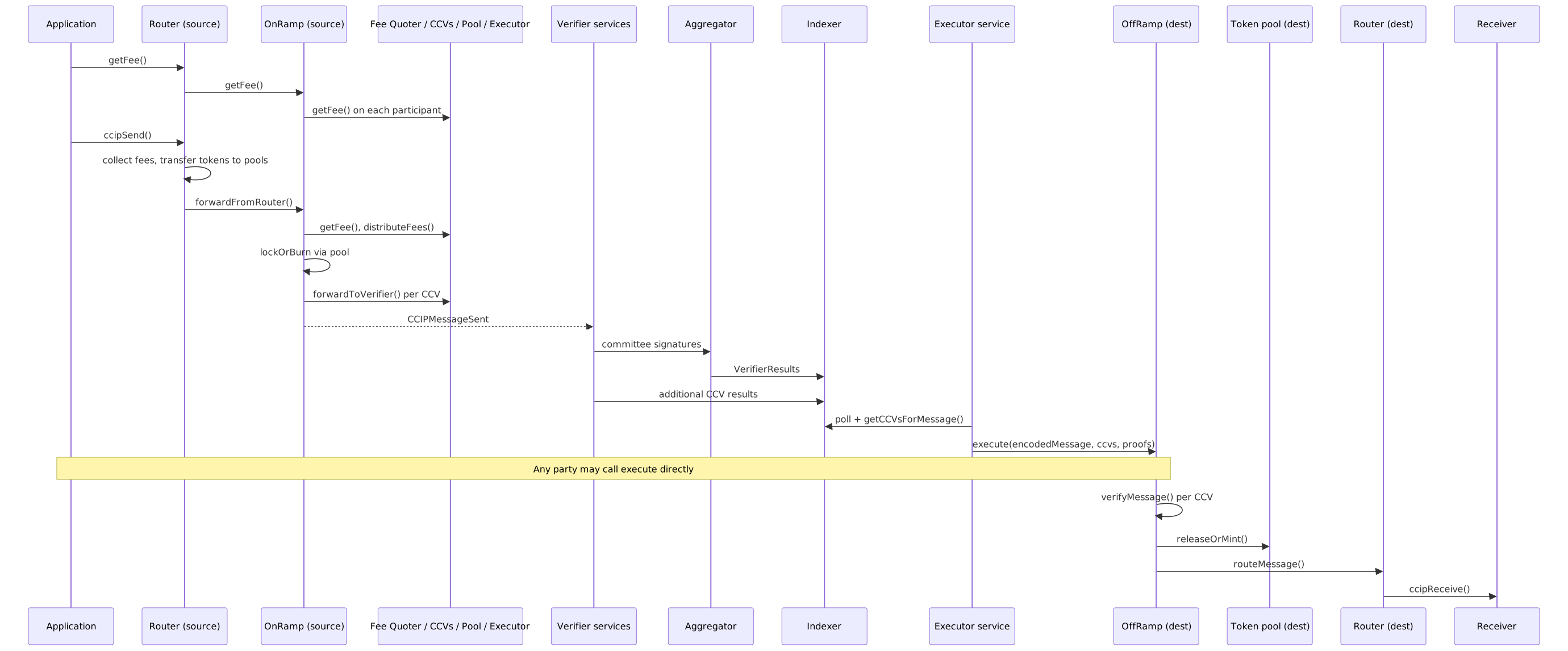
End-to-end CCIP 2.0 message lifecycle.
Phase 1: Source-chain send
1.1 Quote the fee
The application calls Router.getFee(destChainSelector, message).
- The Router resolves the active OnRamp for the destination and delegates to
OnRamp.getFee(). - If
feeToken == address(0), the Router treats payment as the native token (internally using the wrapped native address for pricing). OnRamp.getFee()builds the same verifier and executor list that send will use, then queries:- Fee Quoter: converts the combined gas and byte overheads into an execution cost on the destination chain, and returns the fee token price the OnRamp uses to convert every fee component into the fee token.
- Each CCV:
getFee()per verifier (flat USD cents plus gas/byte components). - Token pool:
getFee()if the pool implements the V2 interface (skipped if no token transfer). V1 pools, and V2 pools without a custom fee config, use the Fee Quoter's token transfer fee instead. - Executor:
getFee()unless the no-execution address is selected (zero executor fee).
getFee()must match the send path. The same logic runs again insideforwardFromRouter(), and the send reverts if that recomputed fee is higher than the amount paid.
If paying in an ERC-20, the application approves the Router for the quoted amount before sending.
1.2 Send via the Router
The application calls Router.ccipSend(destChainSelector, message) with the payload, tokens (if any), fee token, and extraArgs in the message. New integrations should use ExtraArgsV3 (CCVs, executor, finality, gas limit, token receiver for non-EVM destinations only, token/executor args). Existing applications can continue sending legacy extra args on CCIP 2.0. The OnRamp normalizes them internally before building the message.
Supported extraArgs formats (EVM source → EVM destination):
| Format | When used | What the sender controls | CCIP 2.0 defaults applied |
|---|---|---|---|
ExtraArgsV3 | New integrations | CCVs, executor, finality, gas limit, token/executor args | Lane default CCVs/executor only when the sender passes zero-value placeholders |
GenericExtraArgsV2 | Existing v1.x-style apps | Gas limit (allowOutOfOrderExecution was deprecated) | Chainlink Committee Verifier; Chainlink executor; messages wait for full finality on source |
EVMExtraArgsV1 | Existing v1.x-style apps | Gas limit only | Same as above |
Empty extraArgs | Apps that omit extra args | Nothing | Same as above, plus the destination chain's default gas limit |
Router (ccipSend):
- Reverts if the destination lane is not supported (
isChainSupported) or the RMN contract reports a curse. - Re-computes the fee via
OnRamp.getFee()(validates that the fee token is allowed). - Native fee token: wraps
msg.valueand transfers the wrapped native to the OnRamp. - ERC-20 fee token:
transferFromthe application to the OnRamp;msg.valuemust be zero. - For each token in the message:
transferFromthe application to the token pool (pool resolved viaOnRamp.getPoolBySourceToken()). - Calls
OnRamp.forwardFromRouter(destChainSelector, message, feeTokenAmount, msg.sender), passingmsg.senderas the recorded source sender in the message.
1.3 OnRamp processing (forwardFromRouter)
1. Parse extra args and apply defaults
- If
extraArgscarries the V3 tag (0xa69dd4aa), decodesExtraArgsV3directly. - Otherwise, calls
FeeQuoter.resolveLegacyArgs()to extract the gas limit from V1/V2 legacy formats, then applies CCIP 2.0 defaults for everything else. - Resolves CCVs, executor, finality, gas limit, token receiver, and args into an internal V3-shaped struct.
- Applies the lane default executor when the sender omits one. Applies the lane default CCVs when the sender omits a verifier list (except on token-only transfers: no data, one token, and a zero gas limit) or includes an
address(0)placeholder. - Validates the destination receiver address length for the destination chain family.
2. Merge verifier lists
Final CCV list = sender preferences + lane defaults (where applicable) + lane-mandated (always) + pool-required (from getRequiredCCVs() on V2 pools, or lane defaults for V1 pools).
Computes ccvAndExecutorHash from the final CCV list and executor. This hash is embedded in the message for offchain validation only; the destination chain does not check it.
3. Compute and distribute fees
- Calls
getFee()on each CCV, the pool (if applicable), and the executor. These are the same participants as in the quote path. - Sets
executionGasLimitto the sum of the receipt gas components (CCV verification gas, pool overhead, executor execution cost, user gas limit) plus the Fee Quoter's per-byte gas for the quoted byte overheads. - Reverts with
InsufficientFeeTokenAmountif the fee paid is less than computed. _distributeFees()transfers fee-token payments to each receipt issuer: the CCVs, the executor, and the pool if it is a V2 pool. The network fee and any V1 pool fee stay on the OnRamp.
4. Lock or burn tokens
- At most one token per message.
- Calls the pool's
lockOrBurn()with finality and token args; pool output (destPoolData) is encoded into the message. - Validates that the pool extra data fits within the byte overhead quoted in the fee receipt.
5. Encode message and compute message ID
- Assigns the next per-lane
messageNumber(monotonic, starts at 1). - Encodes
MessageV1and setsmessageId = keccak256(encodedMessage).
6. Register with each CCV (outbound)
For each CCV in the final list:
- Resolves the outbound implementation via
ICrossChainVerifierResolver.getOutboundImplementation(). - Calls
ICrossChainVerifierV1.forwardToVerifier(), which runs the CCV's outbound send hook and returns a verifier blob: CCV-specific bytes the OnRamp includes inCCIPMessageSent.verifierBlobs. Offchain verifier nodes use this blob to match the message and build attestations. For example, the Committee Verifier returns its 4-byte version tag, which committee nodes include in the hash they sign.
7. Emit event
Emits CCIPMessageSent with:
messageId,encodedMessage,receipts(fee breakdown per issuer), andverifierBlobs(per-CCV hints).sender(original application address),feeToken, and the token amount before pool fees.
Curse status is checked at both the Router and the OnRamp, so a send to a cursed destination reverts.
Phase 2: Offchain verification
2.1 Shared verifier pipeline
Each CCV type's offchain service:
- Monitors the source chain for
CCIPMessageSent. - Filters events where
receiptsinclude an entry issued by that CCV's onchain resolver address. - Decodes
encodedMessageand confirmsmessageIdmatcheskeccak256(encodedMessage). - Reads the requested finality from the message and waits until the source chain meets that verifier's onchain policy (full finality by default).
- Checks RMN curse status. Cursed source or destination subjects are not attested.
- Reads
verifierBlobsfrom the event (the CCV-specific bytes thatforwardToVerifierreturned on send) and uses them to match the message and build attestations. For the Committee Verifier, the blob is the 4-byte version tag that nodes include in the hash they sign.
2.2 Committee Verifier (default)
For each message:
- Each committee node independently signs a hash over the verifier version tag and
messageId(which commits to the full encoded payload). - Posts the signature to the Aggregator over an authenticated channel.
- The Aggregator validates each ECDSA signature, persists it, and checks quorum for the source chain.
- When quorum is reached, it stores the combined
VerifierResultand exposes it via a read API.
2.3 Additional CCVs
Each additional verifier service operates independently, with its own monitoring, finality wait, and publication path. Results are stored in that verifier's own database and exposed via its REST API (not the Aggregator). Some apply only when their specific token is transferred.
Attestations are bound to messageId. Offchain services use the onchain message ID and do not derive a different identity.
Phase 3: Indexing
3.1 Discovery
- The Indexer polls the Aggregator using a sequence cursor to discover newly verified messages without scanning by message ID.
- For each discovered message ID, it checks local storage for which CCV attestations are still missing.
3.2 Collection
- Committee Verifier results: fetched from the Aggregator (by message ID or via the cursor stream).
- Additional CCVs: fetched from each configured verifier's API.
- Missing attestations are retried until present, or until operational timeout policies apply.
3.3 Storage
- Attestations are stored keyed by message ID and CCV identity.
- Only CCV types in the Indexer's configuration are collected. If a message requires an untracked CCV, automated execution may stall until the configuration is updated.
Executor services may bypass the Indexer and query the Aggregator and verifier APIs directly.
Phase 4: Destination-chain execution
4.1 Prepare submission
Once the required attestations exist:
- The application or any party calls
OffRamp.execute(encodedMessage, ccvs, verifierResults, gasLimitOverride)on the destination chain. - The
ccvsandverifierResultsarrays must be the same length. Each entry pairs a CCV resolver address with its proof bytes. - A
gasLimitOverrideof0means use the gas limit from the message; a non-zero override must be ≥ccipReceiveGasLimitin the message. Example: if the message specifies200_000, pass0to use200_000, or300_000to grant more headroom;100_000reverts.
The executor chosen at send time governs fees and does not restrict who may call execute.
4.2 Default executor service (offchain)
The default executor service runs these checks before submitting:
- Reads
OffRamp.getCCVsForMessage()(view), which re-derives the required and optional CCVs from the receiver, pool, and lane config for the encoded message (the same logic as onchain execution). - Confirms all required CCVs have attestation results and that the optional quorum is met.
- Checks curse status and the
OffRampexecution state for the message ID (skips if already SUCCESS). - Submits
execute(); retries on FAILURE within a configured window (currently 8h).
If another party has already reached SUCCESS, the service skips the message.
4.3 OffRamp entry checks (execute)
Before execution begins, the OffRamp validates:
- The source chain is not cursed and is enabled in lane config.
onRampAddressin the message matches an allowlisted OnRamp for that source chain.offRampAddressin the message matches this OffRamp contract.destChainSelectormatches the local chain.- The message has not already executed successfully (a retry from FAILURE or a first attempt from UNTOUCHED is allowed).
Sets the execution state to IN_PROGRESS, then calls executeSingleMessage() internally (with a gas buffer so state can be updated even if inner execution runs out of gas).
4.4 OffRamp message processing (executeSingleMessage)
1. Resolve required CCVs (independent of submitter)
Re-derives the required set via _getCCVsForMessage() from:
- Receiver:
getCCVsAndFinalityConfig(sourceChainSelector, sender)if the receiver implements the V2 interface (required + optional CCVs with an optional threshold). If the receiver does not implement it, or returns no required CCVs and a zero optional threshold, the lane default CCVs apply. - Token pool: inbound
getRequiredCCVs()(or lane defaults for V1 pools). - Lane configuration: lane-mandated CCVs are always included.
For token-only transfers, receiver CCVs and sender-level defaults are omitted; pool and lane-mandated verifiers still apply.
2. Verify CCV quorum
This step runs before token release or receiver delivery. The OffRamp first confirms quorum at the CCV-set level, then calls each CCV's inbound verification.
CCV-set quorum (OffRamp):
- Confirms every required CCV resolver address is present in the submitted
ccvsarray, and reverts withRequiredCCVMissingif not. - Confirms the optional CCV threshold is met when the receiver specified optional verifiers, and reverts with
OptionalCCVQuorumNotReachedif not. - Extra CCV entries beyond what is required or optional are ignored (not verified).
- Only CCVs that pass this set-level check proceed to
verifyMessage.
Per-CCV verification (resolver → implementation):
For each CCV to verify:
getInboundImplementation(verifierResults[i])on the CCV resolver reads the 4-byte version tag prefix from the proof and returns the inbound implementation address. If that version is unregistered, the resolver returns the zero address and the OffRamp reverts withInboundImplementationNotFound.verifyMessage(message, messageId, verifierResults[i])on that implementation must succeed (not revert) for execution to continue.
The messageId passed here is keccak256(encodedMessage), the same ID that committee nodes hash with the version tag and sign offchain, and that the Aggregator keys results on.
Checks inside CommitteeVerifier.verifyMessage:
The Committee Verifier is the baseline CCV on every lane. Its destination-side verifyMessage performs onchain checks on the decoded message and the proof bytes. Offchain, each committee node signs keccak256(versionTag ‖ messageId) and posts to the Aggregator. When quorum is reached, the Aggregator packs the quorum signatures (sorted by signer address) and exposes them as CcvData in the VerifierResult. Executors pass this blob as verifierResults[i] at execution time.
- RMN curse: reverts if the message's source chain selector is cursed.
- Minimum length: the proof must contain at least the version tag and signature-length prefix; otherwise
InvalidVerifierResults. - Version tag match: the first 4 bytes must equal this implementation's immutable
versionTag(); otherwiseInvalidCCVVersion. This binds the proof to this verifier type and prevents cross-CCV replay. - Signature length sanity: the declared signature length must not exceed the bytes available; otherwise
InvalidVerifierResults. - ECDSA quorum validation: recomputes the signed hash as
keccak256(bytes.concat(verifierVersion, messageId))and validates signatures:- Loads the signer allowlist and threshold configured for this message's source chain selector on the destination Committee Verifier. Reverts
SourceNotConfiguredif none. - Rejects if the chain ID at deployment differs from the current chain ID (
ForkedChain). This defends against replay on a forked network. - Requires at least threshold signatures in the blob; otherwise
WrongNumberOfSignatures. - For the first threshold signatures (in order): recovers the signer with
ecrecover, checks the signer is in the allowlist (UnauthorizedSigner), and enforces strictly increasing signer addresses (NonOrderedOrNonUniqueSignatures) to prevent duplicate votes. - Additional signatures beyond the threshold may be present; only the first threshold are validated (a gas optimization).
- Loads the signer allowlist and threshold configured for this message's source chain selector on the destination Committee Verifier. Reverts
What a successful check guarantees:
- The proof authorizes this exact message ID, which commits to the full encoded payload (receiver, tokens, data, finality, etc.), so the proof cannot authorize a different message or a partial edit.
- At least a quorum of independent, allowlisted committee signers attested to that ID for this verifier version.
- The attestation cannot be applied while the source chain is cursed, or through the wrong CCV implementation.
Failure behavior:
Any revert from verifyMessage fails the entire executeSingleMessage call. No tokens are released and the receiver is not called. The message ends in the FAILURE execution state, which is retryable.
Additional CCV types use the same resolver routing and OffRamp call pattern, but their verifyMessage validates their own proof formats (for example, Circle CCTP attestation bytes or Lombard attestation bytes) instead of committee ECDSA quorum.
3. Release or mint tokens
- If the message includes a token transfer: calls the pool's
releaseOrMint()with the source sender, source chain, and finality from the message. - Delivers to the
tokenReceiverin the encoded message. On the source chain, the OnRamp sets it to the message receiver when the sender doesn't specify one. - Confirms the delivered amount via balance delta (unless the pool itself is the receiver).
4. Deliver to receiver (if not token-only)
- Skipped when
datais empty andccipReceiveGasLimitis zero, when the receiver is not a contract, or when the receiver does not implement the receiver interface (the pure token-only path). - Otherwise calls
Router.routeMessage()→ the receiver'sccipReceive(Any2EVMMessage)with exact gas enforcement. - The
execute()caller (executor or manual submitter) never calls the receiver directly; the Router does. InccipReceive, verify thatmsg.senderis the Router. The original source-chain application ismessage.senderin the decoded message.
If ccipReceive reverts, the entire execution attempt fails atomically (tokens are not successfully delivered in that attempt).
4.5 Execution outcome
- SUCCESS: recorded in
s_executionStates[messageId]; the message cannot be executed again. EmitsExecutionStateChanged. - FAILURE: recorded; the message may be retried. Emits
ExecutionStateChangedwith error data. - A retry that fails again reverts the whole transaction with
NoStateProgressMade, so wallets and tooling see the failure. The message stays in FAILURE, ready to be retried once the underlying issue is fixed.