
Policy Management
This page explains in depth how ACE's Policy Management system works — the design rationale, the execution model, and how the components interact. For a high-level overview of the components themselves (PolicyProtected, PolicyEngine, Policies, Extractors), see the Architecture page.
Why separate compliance from business logic?
Hardcoding compliance rules directly into a smart contract makes your application rigid and difficult to maintain. Every time a regulation changes or a new rule is required, you face a contract upgrade or redeployment — a costly, risky process that requires re-auditing.
Policy Management solves this by separating your application's core logic from its compliance rules. Your contract handles what it was built to do (transfers, minting, trading), while a separate layer of modular policies handles the compliance checks. Policies can be added, removed, reordered, or reconfigured through the Policy Manager without ever touching your application contract.
This separation provides:
- Adaptability — Respond to regulatory changes by updating policies, not your core contract.
- Auditability — Each policy is a small, focused contract that can be reviewed and audited independently.
- Composability — Chain multiple policies on the same function to build sophisticated rulesets from simple building blocks.
- Reusability — The same policy contract can protect functions across multiple contracts and chains.
How policy chains work
When a user calls a protected function, the runPolicy modifier intercepts the call and hands control to the PolicyEngine. The engine runs each attached policy in order — a chain of responsibility where each policy's result determines what happens next.
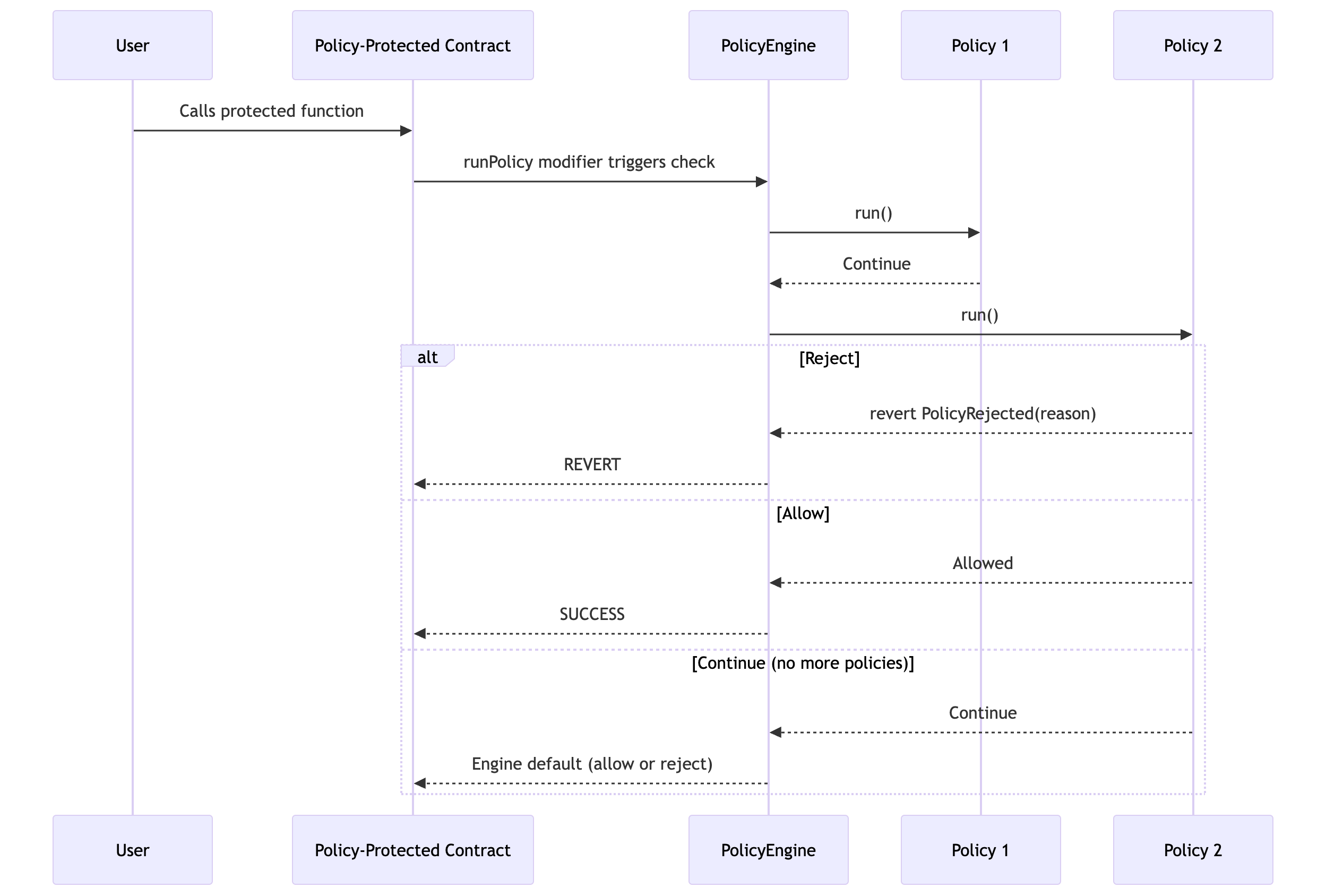
In this diagram, the user calls a protected function on your contract. The runPolicy modifier forwards the call to the PolicyEngine, which begins executing the policy chain. Policy 1 runs first and returns Continue — its check passed, but the decision is deferred. The engine moves to Policy 2, which can produce one of three outcomes:
- Reject — The policy reverts with
PolicyRejectedand a reason. The entire transaction reverts immediately. - Allow — The policy approves the transaction. Execution succeeds without checking any further policies.
- Continue — The check passed but no final decision was made. If no policies remain, the engine applies its configurable default result (allow or reject).
The policy execution flow
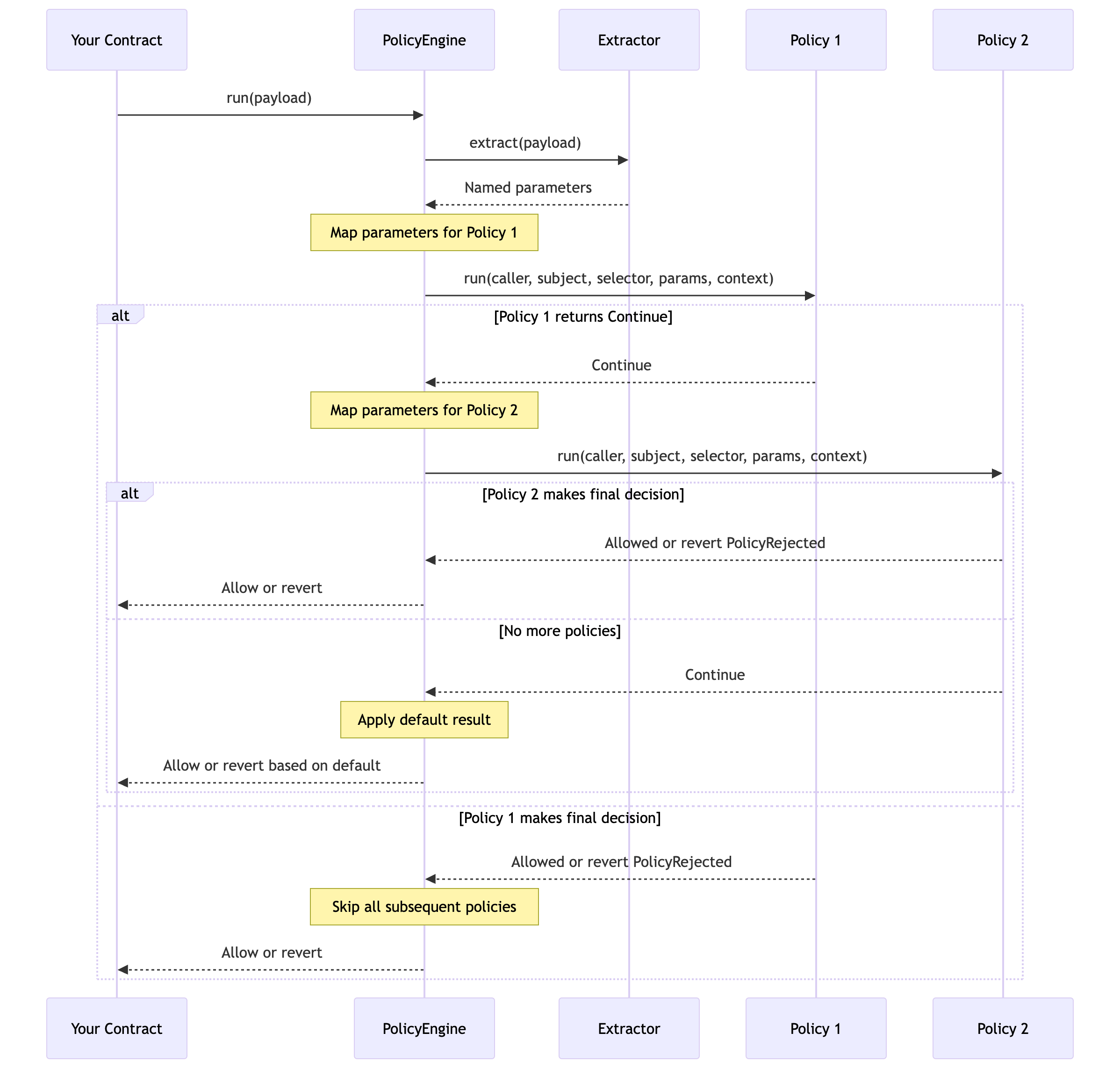
The overview above shows the decision logic. Under the hood, the PolicyEngine does more work before and after each policy runs: it extracts named parameters from the raw calldata and maps the right subset to each policy. This section covers the full execution flow.
- Invocation — The
runPolicymodifier callsPolicyEngine.run()with a payload containing the function selector, caller address, calldata, and optional context. - Extraction — The PolicyEngine calls the registered Extractor for that function selector. The Extractor parses the raw calldata and returns a list of named parameters (e.g.,
to,valuefor an ERC-20 transfer). - Parameter mapping — For each policy in the chain, the engine maps the extracted parameters to the subset that policy needs. This mapping works by name: when a policy is added to a function selector, you specify which parameter names it requires (for example, a sanctions policy might need
fromandto, while a volume limit needs onlyamount). The engine provides only those parameters to each policy. See Worked example: ERC-20 transfer for a concrete walkthrough. - Policy execution — The engine calls each policy's
run()function in order, passing the mapped parameters and context. - Result processing — Based on each policy's response, the engine decides whether to continue, allow, or reject.
Post-run hooks
After a policy returns Allow or Continue, the engine calls that policy's optional postRun() function. This hook is for state changes that depend on the transaction being approved — for example, the VolumeRatePolicy uses postRun() to increment a cumulative volume counter for the current time period.
Most policies leave postRun() empty. It only matters for policies that need to track state across transactions. If a policy rejects, its postRun() is never called — the entire transaction reverts.
Policy outcomes in detail
Each policy's run() function produces one of three outcomes. Understanding them — and their interaction with postRun() — is essential for designing effective policy chains.
Reject
The policy reverts with PolicyRejected and a descriptive reason. This is a final decision: the entire transaction reverts immediately, no subsequent policies run, and the policy's postRun() is not called.
Use Reject for hard blocks: sanctions screening, unauthorized senders, expired credentials.
Allow
The policy returns Allowed. This is also a final decision: all subsequent policies in the chain are skipped. The policy's postRun() is called before the transaction proceeds.
Use Allow sparingly — it acts as a bypass. A common pattern is a BypassPolicy at the start of the chain that allows admin addresses to skip all subsequent checks.
Continue
The policy's check passed, but the decision is deferred to the next policy. The policy's postRun() is called, and the engine moves to the next policy in the chain.
If the last policy in the chain returns Continue and no policy has given a final verdict, the PolicyEngine applies its default result. The default can be configured to either allow or reject — this is set per target contract and can also be set globally for the engine.
Most policies return Continue. This is what makes composability work: each policy handles one concern and passes control forward.
Policy composition
The real power of Policy Management emerges when you chain multiple policies on the same function. Each policy handles one concern, and together they form a comprehensive ruleset:
- A sanctions check rejects flagged addresses.
- A credential check verifies the caller holds a valid KYC credential.
- A volume limit enforces a daily transfer cap.
- A pause control lets an administrator halt the function in an emergency.
By composing these independent checks into a single chain, you build a comprehensive ruleset from simple, auditable building blocks — and you can adjust any single rule without affecting the others.
Policies execute in their configured order. Because Allow and Reject are both final decisions that skip remaining policies, the order you place them in determines which checks actually execute. Different use cases call for different orderings — for example, placing a bypass policy first lets admins skip all checks, while placing a credential check first ensures every caller is verified.
For a detailed guide on ordering strategies, see Policy Ordering & Composition.
The Extractor and Mapper pattern
A key design principle is the separation between parsing data and enforcing rules. Extractors handle parsing; Policies handle rules. This means policies don't need to know how to decode raw calldata — they receive clean, named parameters.
The default flow
For most use cases, the process is straightforward:
- One Extractor per function selector — An Extractor is registered for a specific function signature (e.g.,
transfer(address,uint256)). It parses the calldata and returns all relevant parameters as a named list (e.g.,toandvalue). - Name-based mapping — When you add a policy to a function selector, you specify which parameter names that policy needs. The PolicyEngine's built-in mapper automatically provides the right subset to each policy.
- Multiple policies, one extraction — The Extractor runs once per transaction, and the engine distributes the parameters to each policy by name. This keeps gas costs efficient.
For example, an ERC-20 transfer might have an Extractor that produces to and value. A sanctions policy might only need to, while a volume limit policy only needs value. Each gets exactly what it asks for.
Worked example: ERC-20 transfer
Consider a protected transfer(address from, address to, uint256 amount) function with two policies attached: a RejectPolicy for sanctions screening and a VolumeRatePolicy for daily transfer limits.
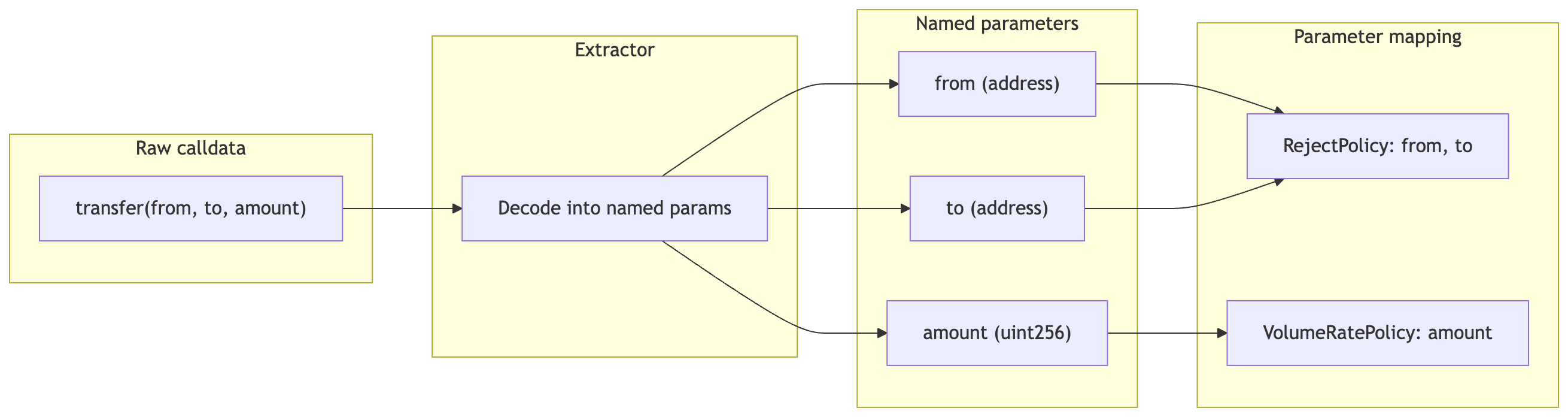
Here is what happens step by step:
- Extraction — The registered Extractor decodes the raw calldata and produces three named parameters:
from,to, andamount. - Mapping for the RejectPolicy — The RejectPolicy was configured to receive
fromandto. The engine provides both addresses to the policy. - Mapping for the VolumeRatePolicy — The VolumeRatePolicy was configured to receive
amount. The engine provides only the transfer size. - Policy execution — Each policy receives exactly the parameters it was mapped to, and nothing else. The RejectPolicy sees two addresses; the VolumeRatePolicy sees one
uint256.
The parameters a policy receives are determined by the mapper configuration — not by the policy itself. A RejectPolicy configured to receive only to would check only the recipient; configured to receive both from and to, it checks both.
Custom Mappers
In rare cases, name-based mapping isn't enough — you need to transform or combine parameters before a policy can use them. This is where a custom Mapper comes in.
A Mapper sits between the Extractor and a specific policy. It takes extracted parameters as input, transforms them, and returns the result for that policy.
For example, a policy that enforces a USD volume limit might need a usdValue parameter, but the Extractor only provides tokenAmount. A custom Mapper could multiply tokenAmount by a price feed value to produce usdValue.
Mappers are set per policy using setPolicyMapper and override the default name-based mapping for that policy only.
The context parameter
Throughout the policy execution flow, a bytes field called context is passed to every policy's run() and postRun() functions. This is a flexible data channel for passing arbitrary, transaction-specific information that isn't part of the protected function's arguments.
Common use cases
- Offchain signatures — A user signs a message offchain (e.g., approving a high-value transaction), and the front end passes the signature in the context. A policy decodes and verifies it.
- Merkle proofs — To check membership in a large offchain allowlist, the caller provides a Merkle proof in the context. The policy verifies it against a stored root.
- Dynamic risk parameters — An integrator passes in offchain risk scores or session data, allowing policies to make context-aware decisions.
Two methods for passing context
The PolicyProtected contract supports two approaches:
Direct argument (recommended for custom functions) — If you control the function signature, add a bytes calldata context parameter and use the runPolicyWithContext(context) modifier. This is the cleanest and most gas-efficient approach.
Two-step method (for standard interfaces) — When protecting a function with a fixed signature (like an ERC-20 transfer), the caller first calls setContext(bytes) on your contract and then calls the protected function in the same transaction. The runPolicy modifier retrieves and clears the stored context automatically.